What to Expect From a CGI Studio for Beauty and Cosmetics
By Victor Haymann, Founder · 13 August 2026
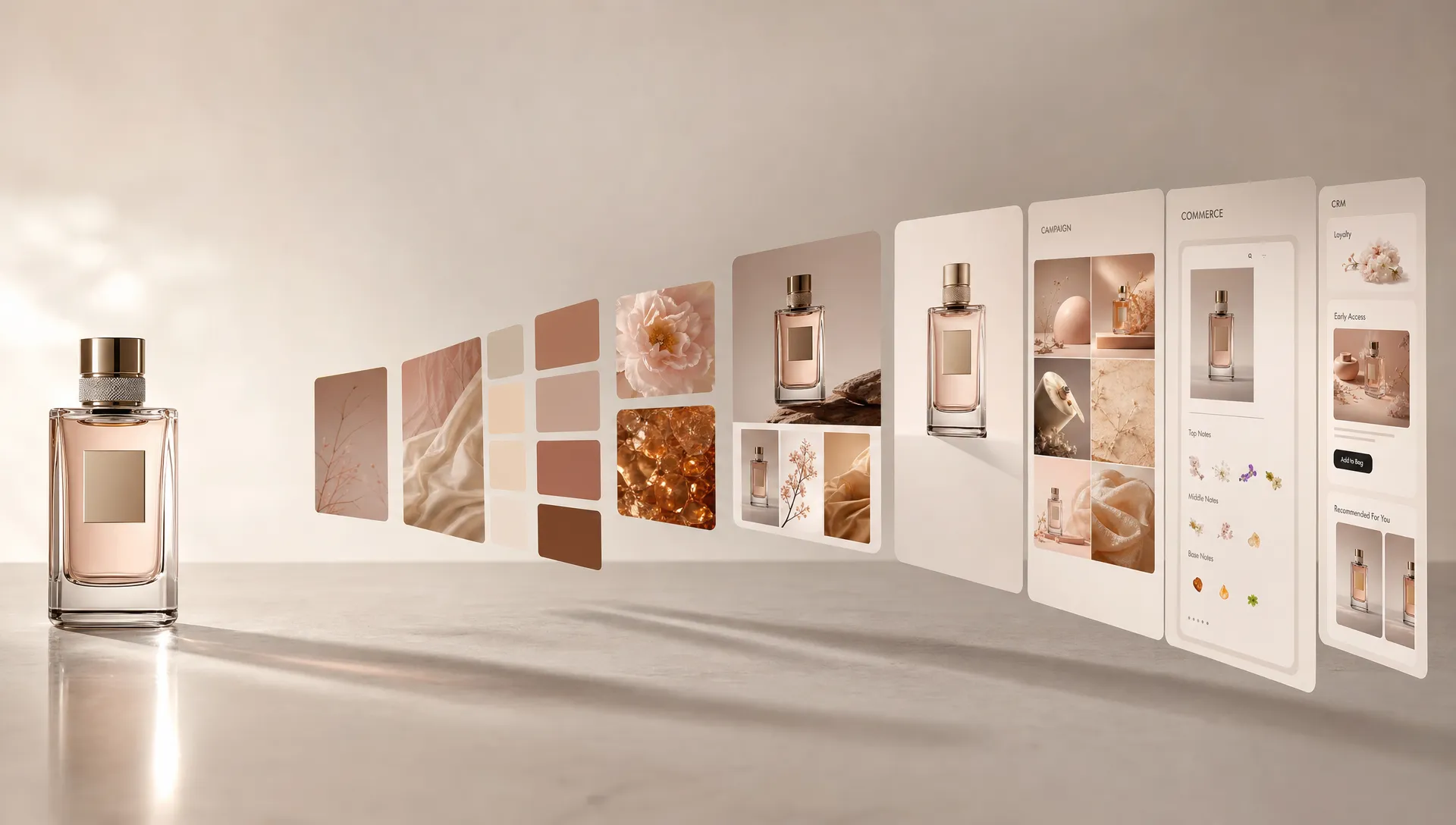
For a beauty or cosmetics brand, CGI should not be asked to imitate a photoshoot. That is too small.
The right partner should help turn a product line into an experience: a lipstick that can be explored in every shade, a fragrance that feels luminous before it is smelled, a skincare ritual that is understood in seconds, a launch toolkit that scales without losing desirability.
That is what to expect from a CGI studio for beauty and cosmetics. Not isolated renders. Not pretty bottles floating in space. A controlled visual system that moves from campaign film to e-commerce packshot to interactive product experience, with the same finish everywhere.
Beauty is intimate. It lives in texture, shine, translucency, gesture and promise. Your CGI partner should understand that before they open any software.
Start with the business result, not the image
A serious CGI studio begins with the commercial moment.
Is the objective to make a launch famous? Improve product page conversion? Reduce content production cost across 40 shades? Create a sensorial CRM experience for loyal clients? Help a market team localize assets without reshooting the campaign?
The answer changes everything.
A hero fragrance film does not need the same architecture as a shade library. A skincare product page does not need the same emotional rhythm as an immersive launch world. A holiday animation for paid social does not need the same level of material control as a permanent e-commerce asset system.
The right studio will ask where the content will live, who will see it, what action it should trigger and how success will be measured. That may mean session time, product interaction rate, add-to-cart rate, sample request rate, CRM opt-in, retail sell-through support or content cost per market.
Luxury beauty does not need more assets. It needs assets that carry desire and move the client closer to action.
Beauty has its own visual truth
Beauty CGI is unforgiving because the product is small, glossy and emotionally charged.
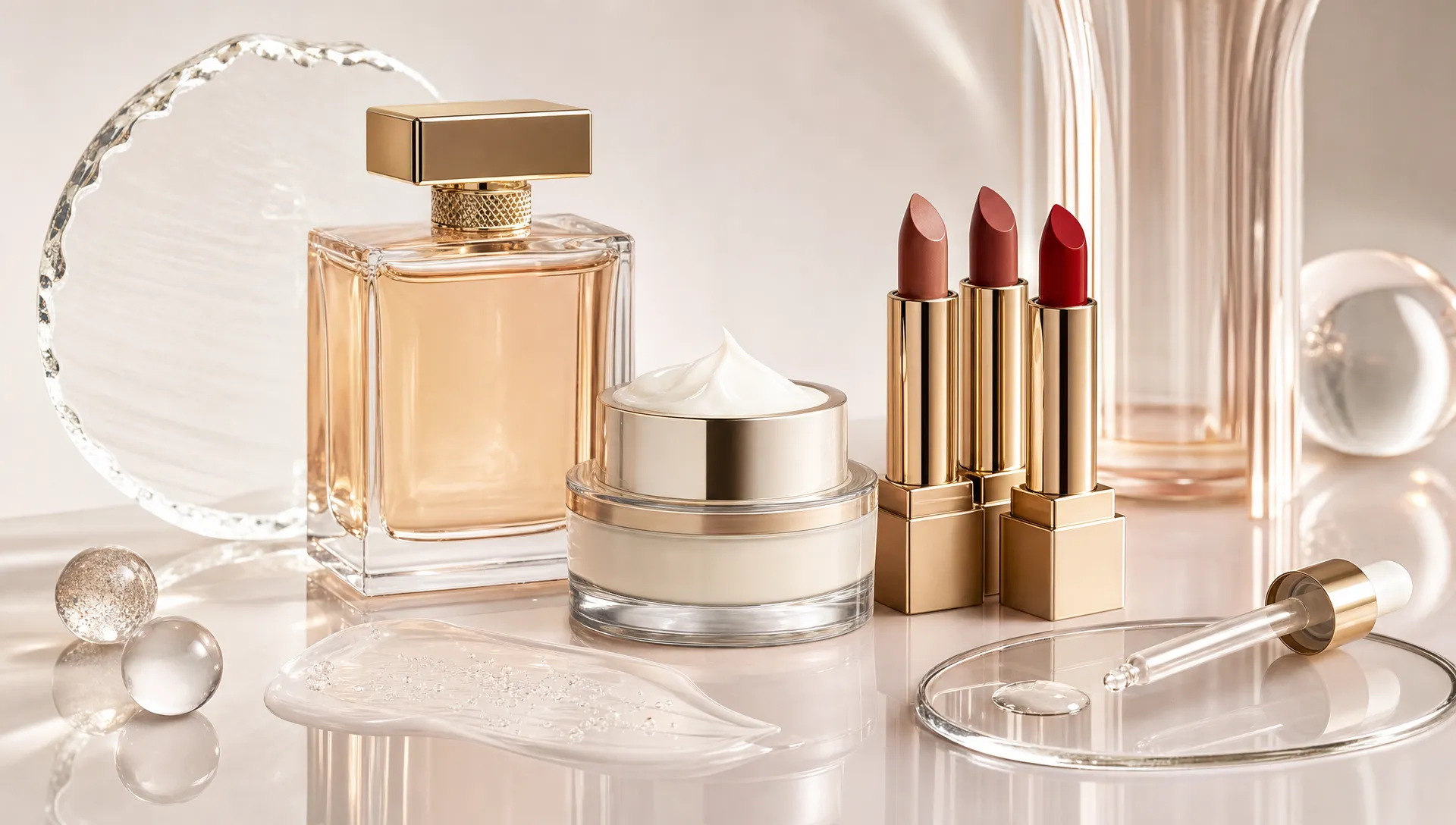
A fragrance bottle must feel weighted. Glass needs depth, thickness and controlled distortion. The cap must catch light like an object the client wants to touch. A lipstick bullet needs the right satin, velvet or lacquer finish. A serum cannot look like plastic gel. A powder compact must show softness without looking dusty. A mascara brush must feel precise, not generic.
This is where many CGI partners fail. They produce a technically clean product, but not a desirable one.
A CGI studio for beauty and cosmetics should understand the codes of formulation and finish. It should know how to make transparency feel premium, how to control reflections on curved packaging, how to handle metallic hot stamping, how to render pearlescence without cheap sparkle and how to make a cream texture look sensorial without overpromising the formula.
This matters because beauty purchases are often made through visual trust. The client cannot smell the fragrance or test the texture through a screen. The image has to carry part of that experience.
Good CGI does not exaggerate. It clarifies. It makes the product feel more legible, more controlled and more desirable than a difficult shoot ever could.
The brand world must come before the bottle
Before production begins, expect a strong studio to define the visual world around the product.
Not a generic moodboard. A real art direction system.
For a couture lipstick, that system may be architectural, precise and high contrast. For skincare, it may be calm, translucent and ritualized. For fragrance, it may be about light, atmosphere, memory and motion. The same bottle can feel clinical, seductive, solar or nocturnal depending on the world created around it.
This is why CGI art direction should never start with software. It starts with brand memory. What does the maison already own visually? What should never be touched? What can be pushed? Which lighting, materials and camera language feel unmistakably on brand?
If you are preparing a campaign, the strongest collaborations happen when the creative idea, material references and usage plan are aligned early. For a deeper view on that discipline, The New Face has shared best practices for art directing CGI campaign imagery across luxury contexts.
The principle is simple. CGI should expand the brand world, not decorate the product.
Expect a reusable content ecosystem
The best beauty CGI work is not one asset. It is a system that can keep working after launch.
A strong studio should be able to build master product models, material references, lighting setups and campaign environments that can be reused across formats. Once the product is accurately built and approved, it becomes much easier to create new crops, new shades, new market adaptations, new motion assets and new commerce visuals without starting from zero.
This is where the economics become hard to ignore.
For high-volume product lines, CGI can reduce dependence on repeated shoots, physical samples, complex logistics and post-production retouching. In the right model, production cost can be divided by three, especially when a brand needs many variations across shades, sizes, markets and channels.
The gain is not only financial. It is creative control.
Every market receives the same product truth. Every crop keeps the same finish. Every launch asset can be adapted without compromising the original campaign idea. For global beauty brands, that consistency is often as valuable as the cost saving.
Expect commerce-ready experiences, not just campaign visuals
Beauty is moving from passive image to active experience.
Clients expect to explore. They want to compare shades, rotate packaging, understand rituals, see refills, discover gift sets and feel the world of the product before they commit. A modern CGI studio should be able to turn high-end product imagery into interactive commerce, without degrading the visual standard.
This is where real-time technology matters, but only because of what it unlocks for the brand.
A lipstick range can become an interactive shade experience. A fragrance launch can become a browser-based world where clients move through the atmosphere of the scent. A skincare ritual can be explained through motion, texture and sequence. A limited edition can be explored in 3D before stock reaches every boutique.
When built with the right infrastructure, these experiences can run directly in the browser, with cinematic quality and no app download. For luxury brands, that removes a major friction point. The experience can be sent through CRM, embedded in a product page, used for paid traffic or presented in retail.
The technology is not the headline. The headline is attention that stays longer and has somewhere to go.
For brands exploring this layer of luxury commerce, the impact of Unreal Engine Pixel Streaming is not technical novelty. It is the ability to deliver a high-fidelity, interactive product experience to the client at the exact moment of interest.
Expect assets built for every channel
A beauty launch rarely lives in one place.
It appears on the brand site, retailer pages, CRM emails, paid social, OOH screens, boutique displays, press kits, wholesale presentations, training tools and internal launch decks. Each channel has its own rhythm and constraint.
A CGI studio should anticipate that from the start.
The product should not be created only for a square Instagram crop. The campaign environment should not collapse when adapted to vertical video. The packshot should not look premium in a hero film and flat on a retailer PDP. Motion assets should not be an afterthought.
Expect your studio to think in deliverable families:
- Hero campaign imagery for launch visibility and brand storytelling
- Product detail visuals for e-commerce, retailers and education
- Motion assets for paid social, CRM and in-store screens
- Shade or variant systems for scalable product lines
- Interactive experiences for exploration, gifting or personalization
- Reusable visual templates for markets and future drops
This is not about producing more. It is about producing once with enough intelligence to serve the full launch ecosystem.
Expect legal and product accuracy to be respected
Beauty imagery sits close to claims.
A skincare texture cannot imply a clinical result that the product is not allowed to claim. A foundation shade system must respect skin tone representation. A fragrance visual can evoke notes and emotion, but it should not confuse the product story. Refillable packaging, applicators and ingredient cues must be shown accurately.
A strong CGI partner understands this balance.
It should be able to make the product more attractive without making it less true. It should welcome reference checks, packaging validation, legal feedback and formulation constraints. It should document approved product details, so future assets do not drift from reality.
This is especially important for global beauty brands. A visual that works in one region may need adjustment in another. Claims, models, rituals, symbols and color meanings can carry different sensitivities. CGI makes adaptation faster, but the brand still needs taste and governance.
Speed without control is not a luxury advantage. It is a risk.
Expect a clear review rhythm
A premium CGI collaboration should feel controlled, not endless.
The review process should move from creative direction to product validation to lighting and material approval to final formats. Each stage should have a purpose. If every comment arrives at the final stage, the work slows down and the visual standard suffers.
The best studios make decisions visible early. They show how the product behaves in light. They test the most difficult materials first. They validate the finish before multiplying deliverables. They separate creative feedback from technical correction.
For beauty teams, this matters because many stakeholders touch the image. Brand, digital, e-commerce, product development, legal, markets and agencies may all have a voice. The studio should help structure that conversation so taste does not get diluted.
Good CGI production is not about accepting every change. It is about protecting the idea while solving the right problems.
Expect performance thinking from day one
A high-end CGI studio should care about what happens after the asset goes live.
For campaign assets, that may mean testing formats, hooks and motion length. For product pages, it may mean measuring interaction with 3D views, image sequence engagement or add-to-cart behavior. For immersive experiences, it may mean tracking session depth, product clicks, sign-ups, store locator usage or sampling requests.
This is especially important for luxury beauty, where emotion and commerce are often separated too early. A beautiful world is valuable. A beautiful world that leads the client to explore a product, choose a shade or request a sample is more valuable.
That is the promise of immersive commerce. It does not replace brand desirability. It gives desirability a path to action. The New Face explores this shift in more detail in its piece on how immersive commerce turns attention into action.
For a CMO or digital director, the question is not whether CGI looks good. It should. The question is whether the experience earns attention, supports conversion and improves the efficiency of content production over time.
What separates a luxury CGI studio from a generic 3D vendor
The difference is visible in the first conversation.
A generic vendor talks about files, polygons and render time. A luxury CGI studio talks about desire, product truth, channel performance and brand control.
It knows that a fragrance launch cannot look like a tech demo. It knows that a lipstick texture is not just a material preset. It knows that a beauty maison needs consistency across global markets, but not sameness. It knows when to push the visual world and when to let the object speak.
The right partner should combine three rare strengths.
First, luxury-grade aesthetics. The work must stand beside campaign photography, not below it. Second, ultra-realistic CGI production. The product must survive close inspection, especially on e-commerce and retail pages. Third, real-time mastery. The same visual standard should be able to extend into interactive experiences when the brand needs engagement, not just exposure.
That combination is what makes CGI strategic for beauty and cosmetics. It turns product content into a platform for launches, commerce, CRM and retail.
Questions to ask before choosing a CGI studio
The strongest beauty brands do not choose a CGI partner on a showreel alone. They look for evidence of taste, control and measurable use.
Ask how the studio handles product accuracy. Ask whether the assets can be reused after launch. Ask how they approach shades, glass, metallic finishes and transparent materials. Ask how they prepare outputs for e-commerce, social, CRM and retail. Ask what KPIs they recommend tracking. Ask whether they can move from still image to motion to interactive experience without changing the visual language.
Also ask what they will not do.
A good studio will tell you when photography is still the better answer. It will tell you when a product sample is too early to reproduce accurately. It will tell you when an interaction adds no value. That honesty is a sign of seniority.
Beauty clients do not need a partner who says yes to everything. They need a partner who protects the product, the brand and the result.
Frequently Asked Questions
What does a CGI studio for beauty and cosmetics do? It creates high-end digital product visuals and experiences for beauty launches, e-commerce, social, CRM, retail and interactive commerce. The best studios do not only make renders. They build a consistent visual system around the product.
Is CGI better than photography for beauty products? It depends on the use case. Photography remains powerful for human emotion, skin and certain campaign moments. CGI is often stronger for perfect product control, shade variations, glass, liquid, packshots, motion assets and scalable global content.
Can CGI accurately show beauty textures and finishes? Yes, when the studio has strong material direction and product references. Lipstick, glass, metallic caps, creams, powders, serums and fragrance liquids all require specific lighting and material work. Accuracy should be validated before assets are scaled.
How should a beauty brand measure CGI performance? Measurement should follow the goal. For commerce, track interaction rate, product page engagement, add-to-cart behavior and conversion. For immersive launches, track session time, depth, product clicks, sign-ups and CRM actions. For production, track cost per asset and speed of market adaptation.
When should a beauty brand involve a CGI studio? As early as possible in the launch planning. Early involvement helps define the product world, build reusable assets, anticipate formats and avoid costly late-stage adaptation. CGI is most powerful when it is planned as part of the launch ecosystem, not added at the end.
Build the product experience clients remember
A CGI studio for beauty and cosmetics should give you more than flawless product images. It should help your brand create desire, scale content intelligently and turn attention into measurable action.
The New Face is a Paris-based creative studio, incubated by NVIDIA, crafting luxury-grade CGI, immersive product experiences and real-time brand worlds for ambitious houses and premium brands, including work across beauty, fragrance and luxury.
If your next launch needs to feel iconic on screen and perform across commerce, CRM and retail, explore The New Face.
Get in Touch
Let's talk about your next project.