Why Unreal Engine Pixel Streaming Changes Luxury Commerce
By Victor Haymann, Founder · 28 July 2026

In luxury, the click is not the purchase. It is the first test of desire.
A client may discover a watch, fragrance, handbag or car online, but the decision still depends on proximity. They need to see the grain, the reflection, the movement, the way a color changes under light. Static product pages were never built for that level of conviction.
Unreal Engine Pixel Streaming changes luxury commerce because it lets brands deliver a cinematic, interactive experience directly in the browser. No app. No compromise on visual quality. No gap between the campaign image and the product experience.
For a luxury maison, that matters because commerce is no longer only a transaction layer. It is a stage. The question is not, “Can the product be displayed?” The question is, “Can the client feel enough confidence, emotion and ownership to move forward?”
What Pixel Streaming actually means for luxury brands
Epic Games describes Pixel Streaming as a way to run an Unreal Engine experience remotely and stream it to a browser while the user interacts with it in real time.
For a CMO or digital lead, the simpler version is this: the heavy visual work happens elsewhere, and the client receives a smooth, high-end experience on their device.
That unlocks something important. A luxury brand can show a product with the same level of control usually reserved for film, CGI campaigns or boutique presentations, while still making it interactive and shoppable.
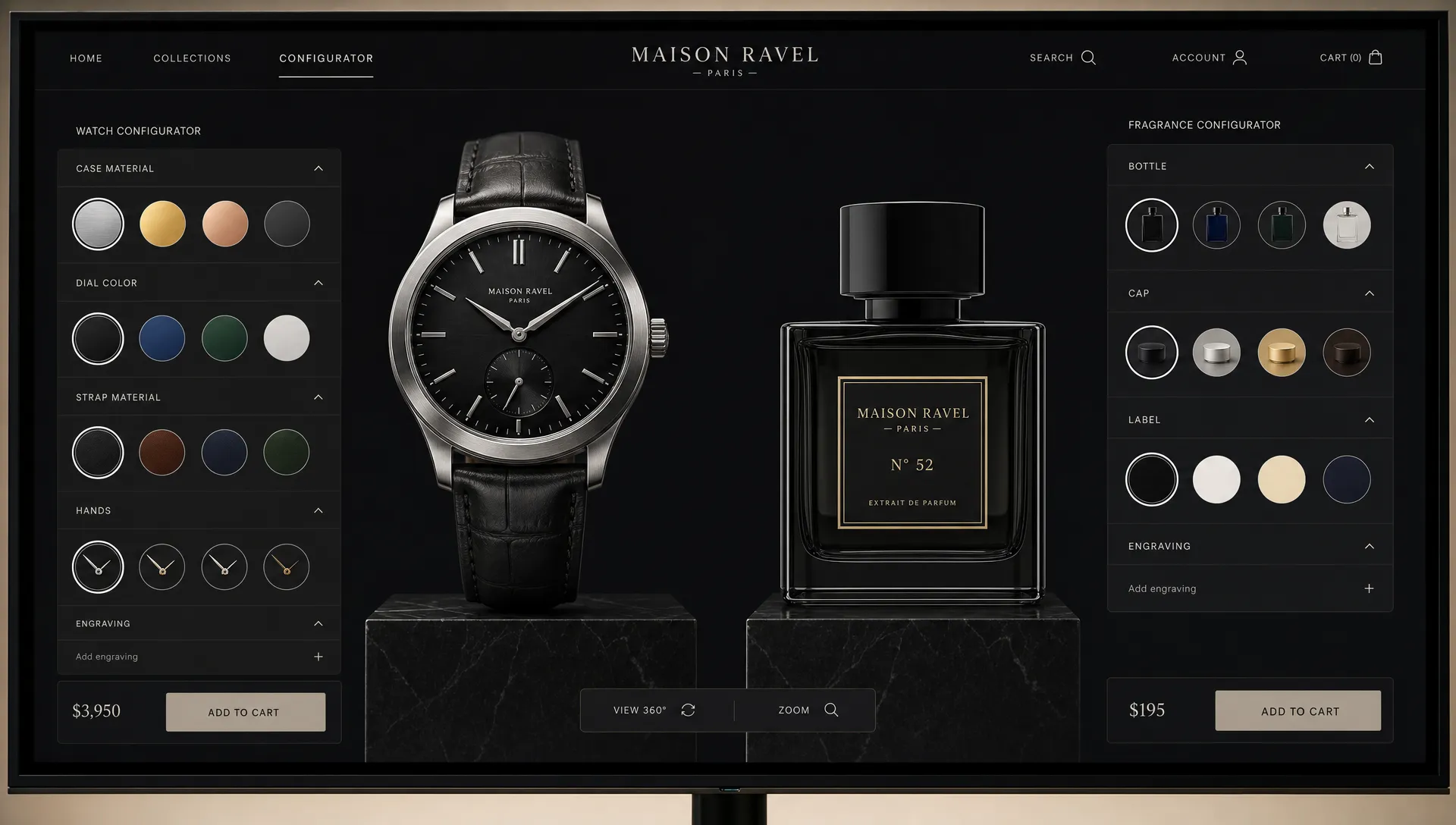
The client can rotate a bottle, change a leather, switch a dial, explore a vehicle interior, compare precious stones or enter a branded world. The experience responds instantly. The image remains premium. The browser becomes a private showroom.
This is why Unreal Engine Pixel Streaming is not just a technical upgrade. It changes the role of e-commerce. It turns the product page into a moment of persuasion.
Why luxury commerce needs more than standard web 3D
Traditional online commerce was designed for speed and clarity. That is enough for low-involvement purchases. It is not enough for high-consideration luxury.
A client buying a fine jewelry piece, a made-to-order fragrance trunk or a premium car configuration is not only comparing options. They are testing certainty. They are asking silent questions.
Will this feel like me? Does the material justify the price? Is the color true? Can I imagine owning it? Would I share this with a partner, a stylist, an advisor or a private client manager?
Standard product photography gives answers in fragments. A 3D viewer gives more control, but it often depends on the user’s device. Quality can vary. Lighting can flatten. Materials can lose their depth.
Pixel Streaming helps protect the brand experience. The maison controls the lighting, the materials, the motion, the rhythm and the level of realism. The client sees a consistent image, whether they arrive from mobile, tablet or desktop.
That consistency is not cosmetic. In luxury, inconsistency reduces trust. If a diamond lacks fire, if a ceramic watch looks plastic, if a leather interior feels flat, the client does not blame the device. They blame the brand.
From product viewing to product ownership
The strongest luxury commerce experiences do not simply show an object. They let the client begin to own it mentally.
This is where configurators become strategic. A client who chooses a strap, a shade, a cap, a dial, a lining or a finish is no longer browsing passively. They are making taste decisions. Each choice increases emotional commitment.
That is why a well-made configurator can become one of the most valuable parts of the funnel. It reduces uncertainty. It creates intent signals. It gives sales and CRM teams a more precise view of what the client actually wants.
The New Face has explored this dynamic in depth in its article on how a 3D product configurator can lift luxury conversion. Pixel Streaming pushes that logic further by allowing the configurator to keep campaign-grade image quality while remaining interactive.
That combination matters. Luxury clients do not want a utility. They want a ceremony that happens to be useful.
What changes inside the funnel
Pixel Streaming is powerful because it touches several commercial moments at once. It can improve acquisition, engagement, product understanding, lead qualification and conversion. Not by adding more content, but by making each interaction more meaningful.
| Commerce moment | Standard experience | Pixel streamed experience | KPI to watch |
|---|---|---|---|
| First product discovery | Static image or video | Interactive cinematic scene | Qualified session time |
| Personalization | Dropdowns and swatches | Real-time visual configuration | Configuration completion rate |
| Product confidence | Multiple photos and copy | Controlled lighting, scale and material behavior | Add-to-cart or lead conversion |
| CRM and clienteling | Generic follow-up | Saved configurations and preference signals | Appointment requests |
| Campaign extension | Separate assets per channel | One visual world adapted to commerce | Cost per qualified interaction |
The value is not only that the experience looks better. The value is that it captures intent with more precision.
A client who spends six minutes configuring a watch and saves two versions is sending a stronger signal than a client who views four static images. A client who explores the interior of a car in a streamed environment is revealing preferences that can shape the next CRM message. A client who enters a fragrance world and chooses a ritual path is telling the brand what kind of story resonates.
That is luxury data with context. Not vanity metrics. Signals sales teams can use.
Why the browser is the new flagship surface
Luxury brands have spent years building apps, microsites, boutique tools and campaign platforms. Many were beautiful. Few became everyday client habits.
The browser wins because it removes friction. A client can open an experience from an email, QR code, paid campaign, clienteling message, product page or private appointment link. They do not need to install anything. They do not need to learn a new interface. They arrive directly in the world of the brand.
That makes Pixel Streaming especially strong for moments where attention is expensive.
A watch maison can invite a collector to configure a rare reference before an appointment. A beauty house can turn a fragrance launch into an interactive ritual. A fashion brand can let VIP clients explore a capsule in a cinematic space. A premium automotive brand can allow prospects to experience color, trim and interior atmosphere before requesting a test drive.
Luxury commerce is also becoming more spatial. Clients increasingly expect to understand environments before they commit, from boutiques and hospitality to residences and private spaces. You can see that expectation in adjacent premium sectors, where companies such as Revo Craft Renovations in Dubai sell modern interiors through clarity, material choices and a controlled vision before execution. Luxury commerce is moving in the same direction. The client wants to see the future experience before saying yes.
The content advantage: one asset, many moments
The hidden cost of luxury content is repetition.
Every colorway needs imagery. Every launch needs motion. Every market needs assets. Every product team needs consistency. Traditional shoots can still be powerful, but they become expensive when the brand needs scale, variation and speed.
A high-end CGI and real-time production model changes the economics. Once the digital product is approved, it can support campaign stills, product page imagery, animation, configurators, immersive worlds and sales tools.
In the right model, production cost can be divided by three compared with repeating physical shoots for every variation. More importantly, the brand gains control. The lighting stays consistent. The material language stays precise. The object can be re-used across the funnel without losing its identity.
This is where Unreal Engine Pixel Streaming becomes more than an experience layer. It becomes part of a broader content system.
The same master product that serves a campaign can become a real-time commerce object. The same visual world that launches a fragrance can become a CRM activation. The same boutique environment can become an immersive clienteling space. For physical locations and heritage spaces, techniques such as Gaussian Splatting can also help turn real environments into navigable digital worlds, a subject explored in The New Face’s piece on 3D Gaussian Splatting for luxury brand worlds.
The result is not “more content.” It is a more intelligent asset base.
What luxury teams should measure
Pixel Streaming should never be treated as a digital novelty. If the experience is commerce-facing, it needs a commercial scorecard.
The right KPIs depend on the product and funnel, but the most useful measures are often simple. How long did qualified users stay? How many completed a configuration? Which variants were saved or shared? Did the experience increase appointment requests, add-to-cart, lead forms, CRM opt-ins or sales advisor conversations?
The goal is to connect emotion to action.
A beautiful experience that does not create intent is a campaign expense. A beautiful experience that increases qualified session time, captures preferences and moves the client toward purchase is a commercial asset.
Before launch, define the conversion moment. It may not always be checkout. For high jewelry, it may be an appointment. For automotive, it may be a test drive request. For fragrance, it may be sampling or CRM opt-in. For couture, it may be a private consultation.
The experience should be built around that moment from day one.
Where Pixel Streaming is strongest
Unreal Engine Pixel Streaming is not needed everywhere. A simple product category with low visual complexity may not justify it. A fast seasonal landing page may perform better with lighter assets.
It becomes powerful when the product needs emotional proof.
That includes high jewelry, watches, premium automotive, beauty, fragrance, fashion, leather goods, interiors and branded worlds. It is especially valuable when personalization is part of the offer, when materials are difficult to photograph, when the product has many variants or when the brand wants to merge storytelling with commerce.
It is also strong for VIP and private client experiences. A streamed configurator can live behind a personalized link. A sales advisor can share a configuration before an appointment. A client can return to a saved version. The experience becomes part of the relationship, not just the website.
That is where luxury digital finally starts to behave like luxury retail. Personal, precise and memorable.
What separates a luxury-grade execution from a tech demo
Many brands have seen impressive demos that never became business tools. The gap is not technology. The gap is taste, direction and commercial discipline.
A luxury-grade Pixel Streaming experience needs three things.
First, it needs visual authority. Materials, reflections, scale and motion must feel right. If the object is not desirable, the interaction cannot save it.
Second, it needs a clear journey. The client should never feel trapped in a technical interface. The experience must guide them, seduce them and move them naturally toward the next step.
Third, it needs measurement. The brand should know what the experience is meant to change and how success will be read.
This is why the partner matters. A generic 3D shop may build a scene. A luxury real-time studio must build a commercial experience with campaign-level aesthetics and KPI logic behind it.
The New Face operates in that space: high-end CGI, real-time product configurators and immersive brand worlds for luxury, beauty, fashion and premium automotive brands. Its NVIDIA incubation gives the studio close access to advanced real-time rendering and streaming technologies, including infrastructure such as NVIDIA GDN. The point is not the badge. The point is the standard it enables: ultra-realistic experiences that can travel through the browser and still feel worthy of the maison.
A simple decision framework
Before investing in Pixel Streaming, luxury teams should ask a few direct questions.
- Does the product need visual proof before purchase or appointment?
- Will personalization increase emotional ownership?
- Can the experience capture useful intent signals for CRM or sales?
- Is the brand losing quality when moving from campaign imagery to commerce?
- Can one real-time asset base support several content and commerce needs?
If the answer is yes to most of these, Pixel Streaming is not a gimmick. It is a serious commerce lever.
The best starting point is often one hero product, one clear audience and one measurable action. Build the experience around a launch, a flagship SKU or a private client journey. Measure it against the current product page or campaign funnel. Then expand only where the numbers and the brand experience justify it.
Luxury does not reward noise. It rewards precision.
Frequently Asked Questions
Is Unreal Engine Pixel Streaming suitable for luxury e-commerce? Yes, when the product needs high visual fidelity, personalization or emotional storytelling. It is especially useful for watches, jewelry, beauty, fragrance, fashion, leather goods and premium automotive experiences.
Does Pixel Streaming require customers to download an app? No. The experience can run in the browser, which makes it easier to launch from a product page, CRM message, QR code, campaign link or clienteling flow.
How is Pixel Streaming different from a standard 3D viewer? A standard 3D viewer usually depends on the user’s device to display the object. Pixel Streaming allows the brand to stream a controlled high-end experience from powerful remote infrastructure, which helps protect visual quality across devices.
What KPIs should a luxury brand track? The most useful KPIs include qualified session time, configuration completion, saved variants, appointment requests, CRM opt-ins, add-to-cart, lead conversion and sales advisor usage.
When should a brand avoid Pixel Streaming? It may be unnecessary for simple products, low-consideration purchases or campaigns where speed matters more than immersion. It is strongest when the experience must create confidence, desire and measurable intent.
The new luxury commerce standard
Luxury brands do not need more digital spectacle. They need experiences that make desire measurable.
Unreal Engine Pixel Streaming matters because it brings together what luxury commerce has often kept separate: the emotion of a campaign, the precision of CGI, the usefulness of a configurator and the accessibility of the browser.
For maisons that sell through detail, atmosphere and confidence, that is a real shift.
If your next launch, configurator or immersive commerce experience needs to feel as crafted as the product itself, The New Face builds KPI-driven real-time experiences with luxury-grade aesthetics and ultra-realistic CGI at the core.
Get in Touch
Let's talk about your next project.