How Gaussian Splatting Brings Fashion Worlds Online
By Victor Haymann, Founder · 1 September 2026
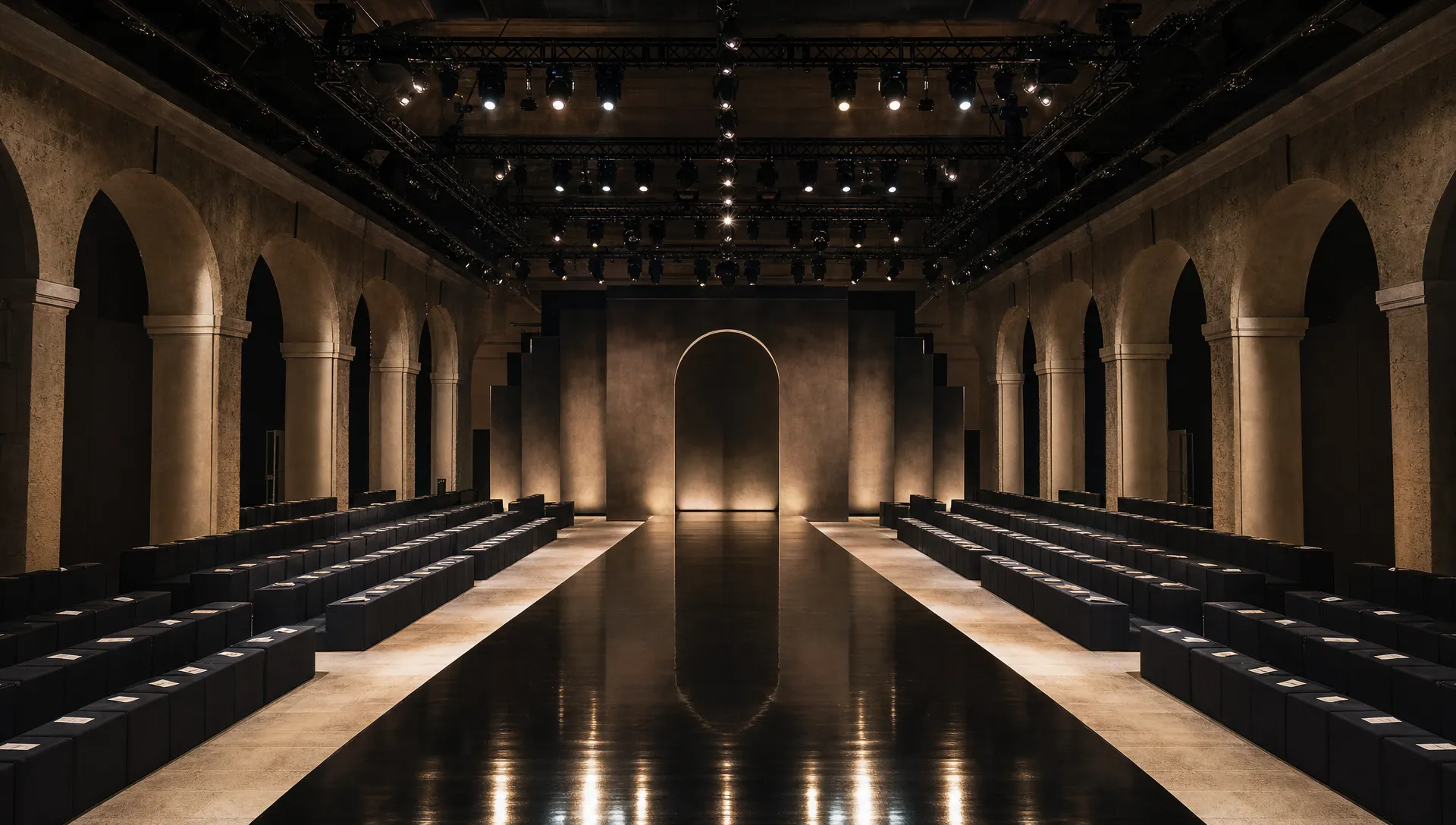
In fashion, Gaussian Splatting is valuable when it does one thing clearly: it keeps the emotion of a physical world alive after the show, boutique opening or campaign set has disappeared.
A runway lasts 12 minutes. A pop-up may last 10 days. A private showroom may only be seen by a few hundred buyers and VICs. Yet those spaces often carry the strongest expression of the collection: the lighting, the proportions, the material tension, the cultural reference, the sense of arrival.
Online, that atmosphere is usually reduced to a video replay, a product grid or a campaign carousel. Beautiful, but passive. Gaussian Splatting changes the equation because it allows a real fashion environment to become a navigable digital world. Not a generic 3D space. Not a game-like approximation. A place that feels tied to the Maison because it comes from the Maison's real visual memory.
For fashion leaders, the question is not whether the technique is impressive. The question is whether it can turn a moment into a measurable destination, one that extends attention, deepens product discovery and supports conversion without flattening the brand.
The digital fashion problem is presence, not pixels
Luxury fashion already has enough high-resolution content. The problem is not the sharpness of the image. It is the absence of presence.
A product page can show a dress with perfect detail and still lose the feeling of why that dress matters. A campaign film can create desire, but it rarely lets the audience choose where to look. A social post can deliver reach, yet its half-life is short and its context is controlled by the platform.
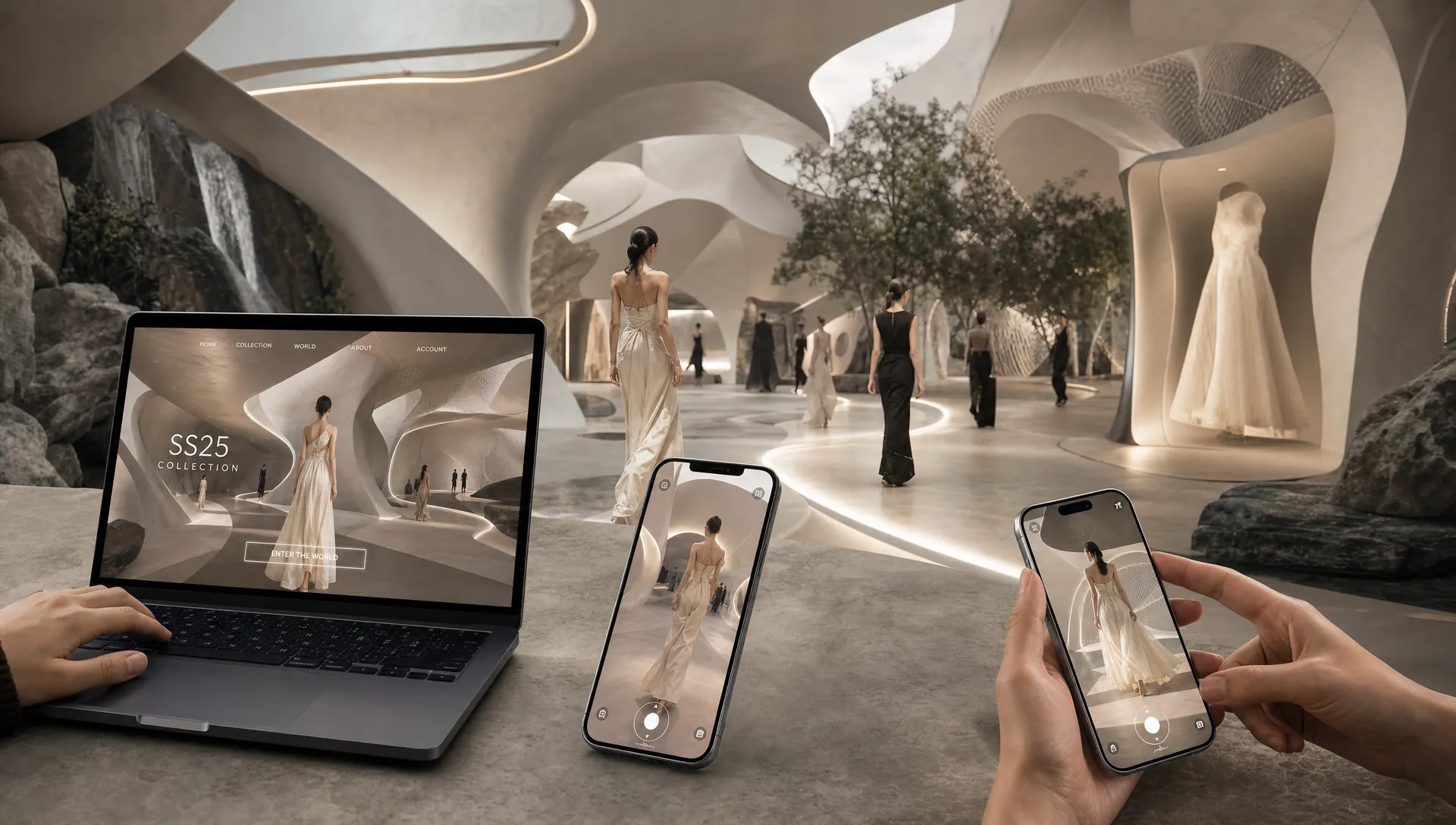
Fashion sells through worlds. A runway set frames a silhouette. A boutique frames a ritual. An atelier frames craft. A campaign location frames an attitude. When those worlds move online, the brand has a chance to create something richer than content: a place the audience can enter.
That matters commercially. More time in the world means more time with the collection. More product interactions mean stronger intent signals. More saved looks, appointment requests and account creations give CRM teams a sharper view of what the audience wants before they reach a store or checkout.
What Gaussian Splatting does in plain language
Gaussian Splatting takes a real space, captured through images or video, and turns it into a three-dimensional scene that can be explored from multiple viewpoints. The result has a specific quality that fashion brands care about: it preserves atmosphere with unusual fidelity.
Reflections on lacquer. The depth of velvet seating. The patina of a historic room. The softness of light on a backstage wall. These details are hard to rebuild from scratch without losing something. Gaussian Splatting keeps much of that lived-in richness.
The original 3D Gaussian Splatting research by Kerbl, Kopanas, Leimkuehler and Drettakis showed real-time rendering at 1080p and 30 frames per second, which is why the technique quickly moved from research circles into cultural, retail and brand applications. The technical point only matters because it unlocks movement. The audience is no longer watching a fixed frame. They can move through the frame.
For a broader luxury view, The New Face has explored what 3D Gaussian Splatting changes for luxury brand worlds. Fashion is one of the clearest use cases because the industry already invests heavily in temporary spaces with enormous emotional value.
Why fashion is such a natural fit
Fashion is seasonal, spatial and theatrical. Each launch creates a world, then moves on. Gaussian Splatting gives that world a second life.
A runway set can become a post-show destination for clients who were not in the room. A flagship boutique can become a remote clienteling environment for international audiences. A campaign set can become a world where the collection is discovered by mood, silhouette or occasion rather than by category alone.
This is especially relevant for luxury houses because access is part of desire. Not every client can attend Paris Fashion Week. Not every high-value prospect can visit a private presentation in Milan, London or Seoul. A well-directed digital fashion world can give them a sense of privileged proximity without pretending to replace the physical event.
The opportunity is not to democratize everything. It is to extend the aura with control.
That distinction is essential. A luxury fashion world online should not feel like a metaverse theme park. It should feel like the brand has opened a door.
From runway moment to commercial journey
A captured space is not an experience by itself. The value appears when the world is designed around the audience journey.
For a runway launch, the visitor might enter through the set, move from key silhouettes to full looks, discover details of construction and save favorite pieces for a stylist consultation. For a capsule drop, the world might guide visitors toward limited products, waitlist access or early purchase. For a VIC audience, it might become a private appointment tool, with selected rooms, personalized edits and direct handoff to client advisors.
This is where fashion brands should be precise. A strong brief is not to make the show immersive. A strong brief is to turn a 12 minute show into 6 weeks of qualified engagement, to increase product interactions during launch week or to generate appointment requests before the collection reaches selected stores.
The world must have a role in the funnel. Awareness, consideration, clienteling and commerce all require different pacing. A press audience may want context and narrative. A VIC may want access and service. An ecommerce visitor may want fewer words and faster product discovery.
When the experience respects those differences, Gaussian Splatting becomes more than visual capture. It becomes a new layer of luxury commerce.
The strongest model combines splatted worlds with CGI products
Gaussian Splatting is exceptional for place, mood and atmosphere. It is not always the best answer for every product detail.
Fashion products still need precision. A couture embroidery, a leather grain, a watch clasp, a fragrance cap or a beauty pack shot may require controlled CGI, photography or a digital product asset built with exacting art direction. The best experiences combine the two: a splatted world for emotional presence, high-end CGI assets for product truth and a real-time layer that makes the journey responsive.
This hybrid model protects quality. The visitor gets the feeling of being inside the world, while the product remains crisp, controlled and commercially usable. It also gives the brand more flexibility. The same world can host different product edits, regional assortments, language layers or clienteling paths without rebuilding the entire environment.
Browser delivery is another decisive factor. A luxury audience should not be asked to download an app to enter a campaign. This is why streaming architecture matters. As we covered in our insight on Unreal Engine Pixel Streaming and luxury commerce, high-end interactive experiences become far more useful when they can run directly in the browser with minimal friction.
What a fashion world can become online
The most immediate use case is the runway extension. The show no longer ends when the lights go down. It becomes a destination for global clients, press, buyers and internal teams. The audience can revisit the scenography, understand the collection structure and explore selected looks at their own pace.
The second use case is the digital boutique. This is not a replacement for retail. It is a remote expression of the store experience, useful for markets where the Maison wants presence before opening a physical location, for clienteling between appointments or for product launches that deserve more than a standard landing page.
The third use case is the campaign room. Instead of separating campaign imagery, film and ecommerce, the brand can place them inside one interactive environment. Visitors enter the world of the campaign, then move naturally toward product discovery. The story and the shopping path sit together.
The fourth use case is archive and heritage. Fashion houses hold decades of spaces, objects and references that rarely become active digital assets. Gaussian Splatting can help turn a historic showroom, exhibition or atelier into an online experience that supports education, loyalty and cultural authority.
The KPIs should be defined before the world is built
A fashion world cannot be judged only by how beautiful it looks. Beauty is the entry price. Performance is the reason to invest.
The right indicators depend on the role of the experience. For a launch campaign, session duration, return visits and look exploration show whether the audience is spending time with the collection. For ecommerce, product interactions, add-to-bag rate, wishlists and assisted conversion are more relevant. For clienteling, appointment requests, saved edits and advisor follow-ups matter more than raw traffic.
This is where immersive work often fails. Brands invest in a spectacle, then measure it like a static microsite. That misses the point. A world can reveal how visitors move, what they ignore, where they hesitate and which products create desire inside a branded context.
Those signals are valuable for CRM and merchandising teams. They can support segmentation, regional buying insights, private client follow-up and future content planning. The world becomes a listening tool as much as a storytelling tool.
Where Gaussian Splatting should not be forced
Not every fashion project needs Gaussian Splatting. If the world is fully imaginary, CGI may be the stronger foundation. If the collection changes daily, a more modular real-time environment may be more efficient. If the core need is perfect product detail on a clean background, traditional photography or CGI product content may be the better investment.
The technique is strongest when the physical environment has value in itself. A runway set. A temporary installation. A flagship interior. A historic room. A private showroom. A craft space. In those cases, the brand is not creating novelty for novelty's sake. It is preserving an asset that already holds meaning.
The art direction must also be disciplined. The camera path, entry sequence, product hierarchy, lighting balance and sound environment all shape the feeling of luxury. A scan without direction can feel accidental. A directed world feels authored.
The same discipline used when art directing CGI campaign imagery should apply here. The medium changes. The standards do not.
What luxury brands should ask before commissioning a fashion world
The first question is simple: what physical moment deserves to live longer online? If the answer is unclear, the experience will feel decorative.
The second question is commercial: what should the visitor do inside the world? Explore the collection, book an appointment, join a waitlist, save a look, discover craft, enter a loyalty journey or purchase directly. One world can support several actions, but it should not feel crowded.
The third question is operational: how will the world be reused? A smart experience can serve the campaign site, CRM invitations, retail training, wholesale presentations, press previews and social cutdowns. When one environment feeds several channels, the economics become stronger and the brand gains consistency.
The fourth question is aesthetic: what must remain unmistakably ours? For luxury fashion, the answer is rarely the technology. It is the atmosphere, restraint, detail, rhythm and sense of access.
The New Face approach
At The New Face, Gaussian Splatting is never treated as a visual gimmick. It is one element in a larger experience system built to serve brand impact and measurable performance.
The studio combines luxury-grade art direction, ultra-realistic CGI production and real-time experience design. Incubation by NVIDIA gives The New Face first tier access to rendering and streaming technologies, but the objective stays simple: create online worlds that feel worthy of the brand and useful to the business.
That combination matters for fashion. A world may begin with a captured runway or boutique, but it often needs CGI product assets, interactive commerce logic, browser streaming, CRM handoffs and a campaign content pipeline. The quality is in the orchestration.
The New Face has worked with houses and brands including Cartier, Dolce & Gabbana, Emilio Pucci, YSL Beauty, Prada Beauty, Franck Muller and Logitech. The common thread is not the category. It is the ambition to make digital experiences feel as crafted as the physical brand.
Frequently Asked Questions
Is Gaussian Splatting useful for fashion ecommerce? Yes, when ecommerce needs more than a product grid. It is strongest for launches, capsules, runway extensions, clienteling and brand worlds where atmosphere can increase engagement and support product discovery.
Does Gaussian Splatting replace CGI or photography? No. It is best for capturing spaces and atmosphere. Product close-ups often still need controlled CGI or photography, especially when material accuracy, finish and commercial consistency are critical.
Can a Gaussian Splatting fashion experience work in a browser? Yes, with the right optimization and streaming approach. Browser access is important for luxury audiences because it removes app-download friction and makes the experience easier to share through CRM, media and ecommerce channels.
What should a fashion brand measure? Useful KPIs include session duration, return visits, product interactions, saved looks, appointment requests, account creations, add-to-bag events and assisted conversion. The right mix depends on whether the goal is awareness, clienteling or commerce.
When should a brand choose Gaussian Splatting over a fully CGI world? Choose it when the real space has emotional or cultural value: a runway set, boutique, atelier, exhibition or pop-up. Choose CGI when the world is imaginary, highly modular or product detail is the dominant requirement.
Bring the world online with purpose
Fashion does not need more digital noise. It needs online experiences with the same precision, restraint and desire as the physical brand.
If your next runway, boutique, pop-up or campaign set deserves to live beyond the moment, The New Face can help turn it into a luxury digital world designed for attention, engagement and measurable commercial value.
Get in Touch
Let's talk about your next project.