Why Watches and Fine Jewelry Brands Are Replacing Photography with CGI
By Victor Haymann, Founder · 29 June 2026
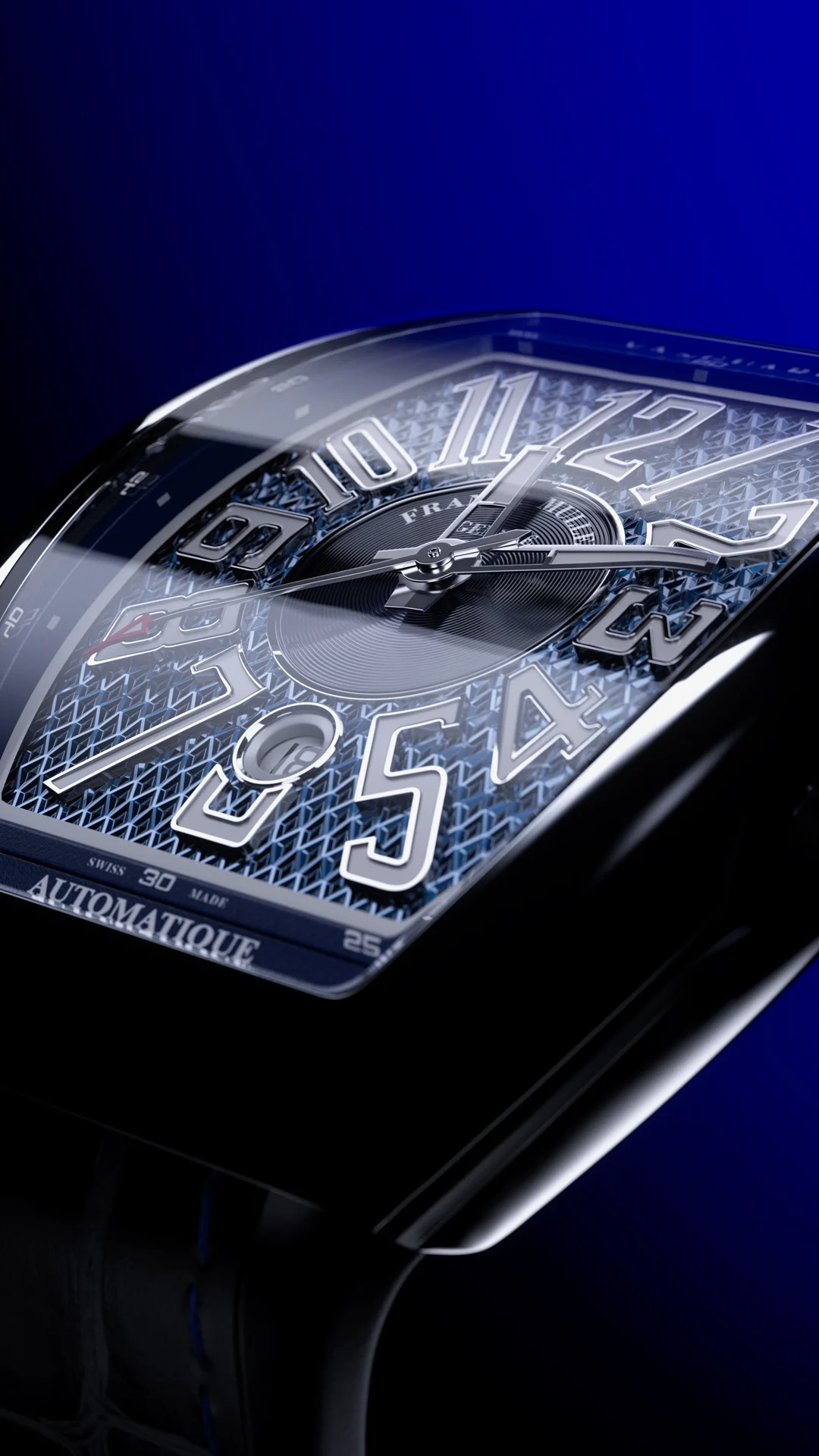
Why jewelry and watch maisons are moving from photography to CGI
If you lead creative or marketing at an independent jewelry or watch house, the math has already turned against the photo shoot. A single high jewelry piece can demand a full day of macro lighting, a specialist retoucher and a reshoot when the stones do not catch light the way the gemologist intended. Multiply that by a collection, then by every metal, every gem variation, every market that needs its own framing, and the catalogue becomes a budget you cannot defend.
CGI changes the equation. We build one photoreal digital master of each piece, then generate every angle, finish, environment and campaign crop from it without ever touching a light again. Macro detail stays perfect and consistent across the entire range. At The New Face we have produced CGI and immersive work for maisons including Franck Muller and Bucherer, and the pattern is the same every time: the moment you have many variations, CGI is not just cheaper, it is the only way to stay coherent.
Why is jewelry so hard to photograph consistently?
Jewelry and watches are the worst case for a camera. The surfaces that make a piece desirable, polished gold, faceted diamonds, sapphire crystal, mother of pearl, are exactly the surfaces that fight the lens.
- Reflections change with every micro-movement of the light and the piece.
- Macro depth of field is razor thin, so the crown is sharp and the lugs are soft.
- Stones flare or go dead depending on angle, and you cannot promise the same sparkle twice.
- Retouching tries to rescue all of this after the fact, slowly and expensively.
The result is a catalogue that looks subtly different from one image to the next. For a Maison whose whole promise is precision, that inconsistency is a brand problem, not just a production one.
With CGI, the light is mathematical. Once a material is calibrated, a diamond refracts correctly in every single render. The 200th SKU looks exactly as deliberate as the first. That consistency is the quiet reason houses make the switch and never go back.
How CGI solves SKU multiplication
The real cost in a jewelry or watch catalogue is not the hero piece. It is the multiplication.
One watch reference can exist in steel, rose gold and yellow gold, with three dial colours and two strap options. That is dozens of permutations of a single product, each of which traditionally needs to be sourced, insured, shipped, shot and retouched. For high jewelry, the physical piece may be a one-off worth a fortune, which makes shooting every variation impossible in the first place.
CGI removes the bottleneck. We model the reference once, then swap materials, gems, dials and straps as parameters. Every combination becomes a render, not a reshoot.
Photography vs CGI for a multi-variant collection
| Factor | Traditional photography | CGI |
|---|---|---|
| New colourway or metal | New shoot or heavy retouch | Parameter change, re-render |
| Physical sample required | Yes, sourced and insured | No, digital master only |
| Macro consistency across SKUs | Varies shot to shot | Identical every time |
| Adding a 360 spin or animation | New production | Same asset, new output |
| Reusing assets next season | Limited | Full, master is permanent |
The digital master is an asset you own. Next season's campaign starts from the same model, so cost goes down each year while photography cost stays flat or rises.
What about global catalogue versioning?
Luxury is a global business with local rules. A piece may need a white background for e-commerce, a marble surface for the European campaign, a warmer environment for the Middle East and a clean studio crop for a retail partner's feed. Each market wants its own version, often at the same time.
With a shoot, every version is a new setup. With CGI, the piece stays untouched and we change the world around it. One digital master produces:
- Packshots on pure white for e-commerce and marketplaces.
- Campaign imagery in rich, art-directed environments.
- Regional variants with different backgrounds, props and lighting moods.
- Vertical and square crops for social, sized correctly from the start.
- 360 spins, configurators and short product films from the very same asset.
Versioning stops being a production problem and becomes a creative choice. You decide how many worlds a piece should live in, not how many shoot days you can afford.
Does CGI actually look real enough for fine jewelry?
This is the question every creative lead asks, and it is the right one. A render that looks like a render destroys desirability instantly.
The honest answer: photoreal CGI for jewelry is hard, and most generic 3D studios cannot do it. The difficulty is entirely in the materials. A gold that reads as plastic, a diamond without correct dispersion, a sapphire crystal with the wrong reflection, any of these and the spell breaks.
Our work is built around getting those materials physically right, because in this category there is no margin for almost. The test is simple and we encourage you to use it: put a CGI image next to a photograph of the same piece and ask whether anyone in the room can tell. If they can, it is not finished. When it is done properly, the CGI is frequently the cleaner, more flattering image, because we control every reflection on purpose.
When does CGI make sense, and when does a shoot still win?
I am not going to tell you photography is dead. There are moments where a real shoot is the right call, usually emotional campaign films with talent, skin and movement.
CGI is the clear winner when:
- You have many variations of the same product.
- The pieces are too valuable, fragile or rare to ship and shoot.
- You need perfect macro consistency across a full catalogue.
- You want to reuse assets across seasons, markets and formats.
- You need motion, 360 or a configurator, not just stills.
For most jewelry and watch catalogues, that describes the majority of the work. The campaign hero might stay photographic. The hundreds of SKUs behind it should not be.
What a CGI catalogue audit reveals
Before committing to anything, the useful first step is to look at your actual catalogue and find where photography is quietly costing you the most. That is what we do in a CGI catalogue audit.
We take your current range and map:
- Which references carry the heaviest variation load, the SKUs multiplying your shoot costs.
- Where macro inconsistency is hurting the brand across product pages.
- How many market versions you are producing and where CGI collapses that work.
- The pieces that are impossible or uneconomical to shoot at all.
- A realistic view of where your spend moves from per-shoot to per-asset.
The outcome is a clear picture of what CGI changes for your specific catalogue, not a generic pitch.
Frequently asked questions
What is a CGI jewelry campaign agency? A studio that builds photoreal digital masters of jewelry and watches, then produces campaign imagery, packshots, films and interactive experiences from them. At The New Face we focus on luxury maisons specifically, where material accuracy is everything.
Is CGI cheaper than a photo shoot for jewelry? For a single hero image, the gap is small. For a catalogue with many variations and market versions, CGI is dramatically more efficient because every variant is a render, not a reshoot, and the master is reusable next season.
Can CGI match the realism of fine jewelry photography? Yes, when the materials are physically calibrated. Gold, diamonds, sapphire crystal and enamel each need to behave correctly under light. This is the hard part and the reason to choose a specialist over a generic 3D vendor.
Do you need the physical piece to create the CGI? It helps for reference, but high jewelry pieces that are one-offs or already sold can be rebuilt from technical drawings, gem specifications and reference photography.
Can the same CGI asset be used for e-commerce and campaign? Yes. One digital master produces white-background packshots, art-directed campaign scenes, social crops, 360 spins and configurators. That single-source approach is the core advantage.
See what CGI changes for your catalogue
If your collection is multiplying faster than your shoot budget, the photo-first model is working against you. The maisons we partner with, including Franck Muller and Bucherer, treat CGI as the backbone of their visual production, not a side experiment.
Look through our recent work to judge the realism for yourself, then let us run a CGI catalogue audit on your range. We will show you exactly where the savings and the consistency are, and we will produce a free CGI test on one of your own pieces so you can put it next to your current photography.
Book a CGI catalogue audit and see the difference on your own product.
Victor Haymann is the founder of The New Face, a Paris creative studio crafting photoreal CGI and immersive experiences for luxury Maisons across jewelry, watches, fashion and beauty.
Get in Touch
Let's talk about your next project.