How Virtual Environments Make Campaigns More Memorable
By Victor Haymann, Founder · 13 July 2026

Most campaigns compete for a few seconds of attention. A memorable campaign does something more valuable: it gives people a mental place to return to.
That is the strategic power of virtual environments. Instead of asking an audience to remember a tagline, a product shot, or a single video frame, a brand can build a world around the message. The audience does not just see the campaign. They enter its logic, explore its visual language, and connect the brand with a setting, mood, and sequence of moments.
For ambitious brands, this shift matters because memorability is not only a creative goal. It influences recall, preference, shareability, and the likelihood that a campaign keeps working after the media spend ends. A well-designed virtual environment can make brand storytelling feel more concrete, more distinctive, and more emotionally available across channels.
Why virtual environments are so effective for memory
Human memory is contextual. We remember where something happened, what it felt like, what we interacted with, and which details stood out from the background. Virtual environments bring all of those memory cues into a brand campaign.
A standard campaign asset usually delivers a controlled message from one angle. A virtual environment creates a broader context. It can include architecture, lighting, motion, product placement, sound direction, character, symbolic objects, and interactive routes. Each element becomes part of a shared brand world.
This matters because people are not built to remember isolated information perfectly. They are better at remembering stories, spaces, and recognizable patterns. In user experience design, Nielsen Norman Group describes “recognition rather than recall” as a core usability principle. The same idea applies to campaigns: audiences are more likely to reconnect with a brand when its cues are visible, consistent, and easy to recognize.
A virtual environment gives those cues somewhere to live.
They turn brand codes into a place
Every strong brand has codes: colors, materials, typography, product shapes, rituals, attitudes, and recurring visual motifs. In a traditional campaign, those codes might appear in a logo lockup or art direction system. In a virtual environment, they can become architecture.
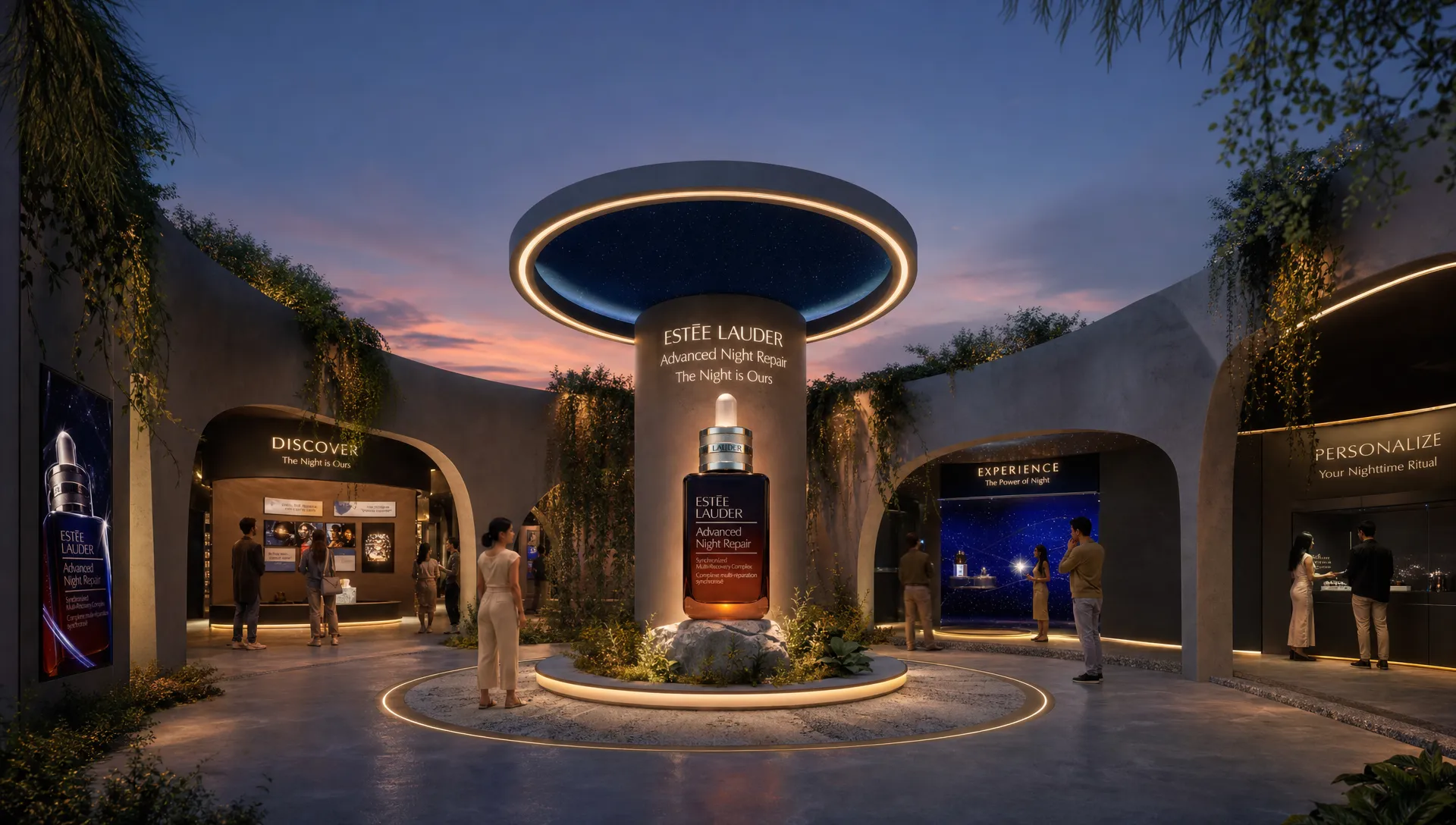
A luxury brand can transform texture, silence, and precision into a digital showroom. A sports brand can turn motion, challenge, and energy into an explorable training world. A technology brand can make invisible systems feel tangible through 3D visualization. A beauty brand can build a surreal product universe where ingredients, skin science, and aspiration occupy the same space.
The advantage is not novelty for its own sake. It is coherence. When a campaign world is built from brand codes, every room, object, image, and interaction reinforces the same memory structure. People may not recall the entire experience, but they remember the feeling of being inside that world.
That is how virtual environments help campaigns move from “nice visuals” to ownable brand territory.
They create spatial anchors for storytelling
A strong campaign needs a story, but not every story has to be linear. Virtual environments allow brands to build spatial storytelling, where meaning unfolds through movement.
In a physical retail space, visitors understand a brand through layout, merchandising, lighting, and sequence. Virtual spaces can borrow that same logic, while removing the limits of physics, budget, and location. A campaign can guide users from problem to transformation, from ingredient to result, from concept to product, or from heritage to future.
Spatial anchors make the message easier to retain. A viewer may remember “the glowing product chamber,” “the floating archive,” “the impossible runway,” or “the city made of data.” These mental landmarks become shortcuts back to the campaign idea.
This is especially useful when the product or message is complex. Instead of explaining everything through copy, the brand can make the audience understand by moving through a designed environment. The result feels less like an ad and more like discovery.
They invite active participation
Interaction strengthens memory because the audience has to make choices. Even small choices can increase attention: rotating a product, entering a room, unlocking a scene, selecting a path, or triggering a transformation.
That does not mean every virtual environment needs to become a game. In many campaigns, light interaction is enough. The key is to give the audience a role. Passive viewers watch the story happen. Active participants feel the story respond to them.
This is one reason immersive media has become such a powerful creative tool. Research and industry work from places like Stanford’s Virtual Human Interaction Lab has explored how virtual experiences can influence perception, empathy, and behavior. For brand campaigns, the takeaway is practical: when people feel present inside an experience, the message can become more personally relevant.
Participation also creates better content loops. Users are more likely to share a moment they discovered than a generic asset they were served. When the environment contains interactive reveals, surreal transitions, or personalized visual moments, it gives the campaign more reasons to travel.
They make emotion easier to design
Memorability is not only cognitive. It is emotional.
People remember campaigns that make them feel something distinct: desire, wonder, belonging, curiosity, tension, nostalgia, confidence, or surprise. Virtual environments allow creative teams to design those emotional states with precision. Scale, color, movement, depth, pacing, and atmosphere can all be tuned to create a specific feeling.
This is important because emotional connection has measurable business value. In a well-known Harvard Business Review article on customer emotions, researchers argue that emotionally connected customers can be more valuable than customers who are merely satisfied. While a single campaign cannot manufacture loyalty on its own, it can create the emotional cues that make a brand more memorable and more meaningful.
Virtual environments are particularly strong at creating wonder because they are not bound by the real world. A product can appear at monumental scale. A city can form around a brand idea. A campaign can move from microscopic detail to cosmic space in seconds. When executed with restraint and purpose, that sense of impossibility becomes memorable.
| Memory driver | How virtual environments support it | Campaign effect |
|---|---|---|
| Distinctiveness | They create an ownable world, not just an asset | The campaign is easier to recognize across channels |
| Context | They place the message inside a setting with meaning | Audiences remember where the idea lived |
| Emotion | They use atmosphere, scale, and movement to shape feeling | The campaign leaves a stronger impression |
| Interaction | They invite users to explore, choose, or reveal | Attention becomes more active and intentional |
| Repetition | They create reusable visual systems and scenes | Brand codes compound over time |
Where virtual environments outperform traditional campaign assets
Virtual environments are not right for every brief. A simple promotion may only need a sharp offer and a fast conversion path. But when the goal is to build meaning, launch something new, or elevate perception, they can outperform conventional creative formats.
They are especially useful for product launches. A new product needs more than visibility. It needs a world that explains why it matters. A virtual launch environment can introduce the product from multiple angles, show scale and detail, and create a reveal sequence that feels more premium than a standard landing page.
They also work well for campaigns where physical production would be limiting. Virtual production and 3D visualization can create locations that would be impossible, expensive, or unsustainable to build physically. This gives creative teams more freedom while helping brands create images and experiences that feel unmistakably ownable.
For fashion, luxury, beauty, automotive, technology, entertainment, and culture-led brands, the value is clear: virtual environments can create visual memory at the level of a flagship, runway, installation, or cinematic universe, but with the flexibility to live across digital channels.
| Campaign use case | Why a virtual environment helps | Example campaign output |
|---|---|---|
| Product launch | Builds anticipation and explains the product world | Interactive reveal space, CGI hero imagery, social cutdowns |
| Brand repositioning | Makes a new identity feel tangible | Immersive brand world, motion system, campaign visuals |
| Digital showroom | Gives audiences a guided space to explore | 3D product environment, virtual merchandising, guided navigation |
| Event extension | Extends a physical moment beyond one location | Virtual installation, post-event experience, press assets |
| Complex storytelling | Turns abstract ideas into visual scenes | Data world, ingredient journey, future city, symbolic landscape |
How to design a memorable virtual campaign environment
A virtual environment is only memorable if it is strategically designed. Spectacle without structure can be impressive for a moment, then disappear from memory. The strongest environments usually start with a clear creative system.
Before designing the space, define the one idea the audience should retain. This is the campaign’s memory target. It might be “this product changes the rules,” “this brand owns future luxury,” “this technology makes complexity effortless,” or “this collection lives between nature and machine.” Every room, transition, image, and interaction should support that idea.
Next, identify the brand codes that must remain recognizable even when the environment becomes surreal. If the world is visually impressive but disconnected from the brand, the audience may remember the art direction and forget who made it. Distinctiveness comes from the relationship between imagination and identity.
A practical design process often includes these principles:
- Build around one unforgettable scene: Every campaign environment needs a hero moment that can live as a still image, motion clip, press visual, and social asset.
- Use interaction with purpose: Let users reveal, compare, move, or transform something that reinforces the campaign message.
- Create a clear route: Even open environments need narrative direction, so the audience understands what to do and what matters.
- Design for multiple outputs: The environment should support the main experience, campaign images, short-form video, event screens, and paid media crops.
- Keep loading and access in mind: A memorable idea loses power if the experience is slow, confusing, or hard to enter.
The best virtual environments feel expansive, but they are rarely random. They are carefully edited worlds.
The role of iconic imagery inside virtual experiences
A virtual environment is not only an experience layer. It is also an image engine.
This is a major advantage for campaign production. Once a virtual world exists, it can generate a family of campaign visuals with consistent lighting, materials, and brand logic. The brand can capture hero shots, product close-ups, social-first compositions, cinematic sequences, and background assets from the same environment.
That consistency helps memory. Instead of producing disconnected visuals for different channels, the campaign can repeat the same spatial language everywhere. A user might first see a still image on Instagram, then encounter a moving version in paid media, then enter the full experience through a website or event activation. Each touchpoint strengthens the others.
This is where creative digital production becomes strategically valuable. The environment is not a one-off stunt. It becomes a modular world that can support storytelling before, during, and after launch.
For brands investing in premium campaigns, this can also improve creative efficiency. A well-planned virtual environment can produce more than a single hero asset. It can become the foundation for an entire visual system.
How to measure whether a virtual environment is memorable
Memorability can feel abstract, but campaign teams can measure useful signals. The exact approach depends on the platform, media plan, and conversion path, yet a few indicators are especially relevant.
Unaided and aided recall surveys can show whether people remember the brand and campaign idea after exposure. Interaction data can show which moments earned attention. Repeat visits, saves, shares, and completion rates can reveal whether the experience created enough value for people to continue engaging. Search lift and direct traffic can indicate whether the campaign made people curious enough to seek the brand out later.
A balanced measurement plan should look at both behavior and perception. Dwell time alone does not prove memorability. A beautiful virtual environment that people explore for several minutes is useful, but the more important question is what they remember afterward. Did they recall the brand? Did they understand the message? Did the experience change how they describe the product or brand?
The most useful metrics often include:
- Brand recall: Whether exposed audiences remember the brand without prompting.
- Message takeaway: Whether they can describe the campaign idea in their own words.
- Interaction depth: How many meaningful moments users complete inside the environment.
- Asset recognition: Whether people recognize campaign visuals across channels.
- Commercial intent: Whether the experience contributes to signups, inquiries, store visits, or product exploration.
A memorable virtual environment should not only look good in a case study. It should create a stronger mental connection between the audience and the brand.
Common mistakes that make virtual campaigns forgettable
The biggest mistake is treating the virtual environment as a visual trend rather than a brand strategy. If the world could belong to any brand, it is not doing enough memory work.
Another common issue is overbuilding. More rooms, effects, and interactions do not automatically create more impact. In many cases, a smaller environment with a sharper concept will be easier to remember than a huge world with no clear hierarchy.
Brands can also lose memorability by hiding the product or message too deeply. Exploration is valuable, but the audience should never have to work hard to understand why the experience exists. The campaign idea needs to be visible early, then enriched through discovery.
Finally, some teams forget to plan for distribution. A virtual environment should be designed with the full campaign ecosystem in mind: web, social, PR, events, retail, CRM, and sales enablement. If the world only exists in one place, its memory potential is limited. If it is translated consistently across channels, it becomes much stronger.
Frequently Asked Questions
What is a virtual environment in a brand campaign? A virtual environment is a designed digital space that audiences can view, explore, or interact with as part of a campaign. It can take the form of a 3D website, digital showroom, immersive product world, virtual installation, or CGI-led campaign universe.
Why are virtual environments more memorable than standard ads? They combine visual distinctiveness, spatial context, emotion, and interaction. Instead of presenting a single message, they give the audience a world of cues that can make the brand easier to recognize and recall.
Do virtual environments always need to be interactive? No. Interaction can help, but it should serve the idea. Some campaigns may need a fully explorable experience, while others may use a virtual environment mainly to create iconic images, films, or virtual production assets.
Which brands benefit most from virtual environments? Brands with strong visual identity, premium positioning, complex products, or culture-led storytelling often benefit most. This includes fashion, beauty, luxury, automotive, technology, entertainment, architecture, and lifestyle brands.
How can a brand avoid making a virtual environment feel like a gimmick? Start with the campaign idea and brand codes, then design the environment around them. The world should make the message clearer, not distract from it. If the audience remembers the environment but not the brand, the strategy needs refinement.
Can virtual environments support both brand awareness and conversion? Yes, when designed intentionally. A virtual environment can build awareness through memorable visuals and storytelling, while also guiding users toward product exploration, signups, inquiries, or retail journeys.
Build a campaign world people remember
Virtual environments make campaigns more memorable because they give audiences something richer than an impression. They create a place, a mood, a sequence, and a set of brand cues that can travel across channels.
For brands that want to move beyond disposable content, the opportunity is not simply to look futuristic. It is to build a campaign world that feels unmistakably theirs.
The New Face crafts virtual experiences and imagery for ambitious brands, helping turn brand storytelling into iconic digital experiences built to be seen, explored, and remembered.
Get in Touch
Let's talk about your next project.